
• Latest
  • Trending
Knowles Offers Leaded Standoff MLCC for Automotive Applications

Knowles Offers Leaded Standoff MLCC for Automotive Applications

YAGEO Extends Antenna Portfolio with Wi‑Fi 6E/7 and Tri‑band GNSS Solutions

YAGEO Extends Antenna Portfolio with Wi‑Fi 6E/7 and Tri‑band GNSS Solutions

SCHURTER Introduces 2410 SMD Fuse for Robust AC/DC Protection

SCHURTER Introduces 2410 SMD Fuse for Robust AC/DC Protection

TDK Releases High Temp 175C Automotive NTC thermistors

TDK Releases High Temp 175C Automotive NTC thermistors

2026 Power Magnetics Design Trends: Flyback, DAB and Planar

2026 Power Magnetics Design Trends: Flyback, DAB and Planar

Vishay Releases Sulfur‑Resistant Chip Resistors

Vishay Releases Sulfur‑Resistant Chip Resistors

Würth Elektronik Introduces Lead-Free SMT Spacers

Würth Elektronik Introduces Lead-Free SMT Spacers

Schurter Releases EKO HV Fuses up to 1000 VDC, 1100 A

Schurter Releases EKO HV Fuses up to 1000 VDC, 1100 A

Empower Releases High-Density Embedded Silicon Capacitors

Empower Releases High-Density Embedded Silicon Capacitors

TDK Unveils 125C Compact DC Link Film Capacitors

TDK Unveils 125C Compact DC Link Film Capacitors

SCHURTER Releases Coin Cell Supercapacitors for Backup Power

SCHURTER Releases Coin Cell Supercapacitors for Backup Power

  • Home
  • ABC of CLR
    • All
    • ABC of Capacitors
    • ABC of Inductors
    • ABC of Resistors
    • Mounting Guidelines
    RF Inductors and Filters

    RF Inductors and Filters

    Power transformers

    Power transformers

    Telecom transformers

    Telecom transformers

    LAN transformers

    LAN transformers

    Transformer Calculation and Applications

    Transformer Calculation and Applications

    Power Inductors 2 (cont.)

    Power Inductors 2 (cont.)

    Power inductors

    Power inductors

    Current compensated chokes

    Current compensated chokes

    Coil with ferrite

    Coil with ferrite

    • ABC of Capacitors
    • ABC of Inductors
    • ABC of Resistors
    • Mounting Guidelines
  • e-Symposium
  • EPCI Membership
  • About
No Result
View All Result
European Passive Components Institute
  • Home
  • ABC of CLR
    • All
    • ABC of Capacitors
    • ABC of Inductors
    • ABC of Resistors
    • Mounting Guidelines
    RF Inductors and Filters

    RF Inductors and Filters

    Power transformers

    Power transformers

    Telecom transformers

    Telecom transformers

    LAN transformers

    LAN transformers

    Transformer Calculation and Applications

    Transformer Calculation and Applications

    Power Inductors 2 (cont.)

    Power Inductors 2 (cont.)

    Power inductors

    Power inductors

    Current compensated chokes

    Current compensated chokes

    Coil with ferrite

    Coil with ferrite

    • ABC of Capacitors
    • ABC of Inductors
    • ABC of Resistors
    • Mounting Guidelines
  • e-Symposium
  • EPCI Membership
  • About
No Result
View All Result
EPCI
No Result
View All Result
Home news collection

Knowles Offers Leaded Standoff MLCC for Automotive Applications

February 20, 2024
Reading Time: 2 mins read
A A
Knowles Offers Leaded Standoff MLCC for Automotive Applications

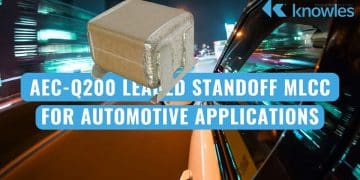
To help PCBs and other physically connected components survive vibration, board bending, thermal mismatching, and stress during thermal cycling, Knowles Precision Devices has launched a range of leaded standoff components, Metal Frame J-Lead Terminal MLCCs, that are qualified to AEC-Q200.

AEC-Q200 is the global standard for stress resistance in passive electronic components in automotive applications. 

Knowles Metal Frame J-Lead Terminal MLCC ceramic capacitors offer enhanced performance under critical testing conditions, including thermal shock and mechanical vibrations.

These high-reliability parts are capable of 3,000 thermal cycles with no degradation of interconnects when mounted on an FR4 board. Compared to a surface-mounted chip, lead flexibility accommodates much more board bending and flexing before internal cracks form.

In arrangements with many components clustered on a board, leaded standoffs are advantageous because they position ceramic elements off the board, ultimately providing more design flexibility. With high voltage ratings, standoffs can help control flashover across the component surface as well. 

Features

  • Options for case sizes 2220 and 2225 in all ranges
  • Enhanced performance under critical testing conditions such as thermal shock and mechanical vibration
  • “J” type leads with a double tabbed connection to MLCC terminals
  • Voltage ratings up to 6kV
  • 3kV and 4kV options to satisfy the demands of DWV testing for 800V battery systems
  • Suitable for industrial and automotive markets

Applications

  • Battery Management
  • EV and HEV
  • Applications Requiring High Voltage Performance Where Stability Under Temperature and Voltage is Critical
  • DC-DC Converters
  • Wireless Charging Resonant Tank
  • PTC Heater Controller

Read the original post at Knowles Offers Leaded Standoff MLCC for Automotive Applications

Previous Post

Bel Fuse Releases Industry’s First 240VAC SMD Resettable Fuse

Next Post

Coilcraft Releases LLC Half-Bridge Transformers for Isolated Gate Driver Bias Supply

Related Posts

YAGEO Extends Antenna Portfolio with Wi‑Fi 6E/7 and Tri‑band GNSS Solutions
news collection

YAGEO Extends Antenna Portfolio with Wi‑Fi 6E/7 and Tri‑band GNSS Solutions

SCHURTER Introduces 2410 SMD Fuse for Robust AC/DC Protection
news collection

SCHURTER Introduces 2410 SMD Fuse for Robust AC/DC Protection

TDK Releases High Temp 175C Automotive NTC thermistors
news collection

TDK Releases High Temp 175C Automotive NTC thermistors

Categories

  • ABC of CLR
    • ABC of Capacitors
    • ABC of Inductors
    • ABC of Resistors
    • Mounting Guidelines
  • e-Symposium
    • ESA SPCD
    • PCNS
  • EPCI news
  • Market Insights
  • news collection
  • Transformer: Parasitic parameters and equivalent circuit

    Transformer: Parasitic parameters and equivalent circuit

    0 shares
    Share 0 Tweet 0
  • Transformer Calculation and Applications

    0 shares
    Share 0 Tweet 0
  • Introduction to Ceramic Capacitors

    0 shares
    Share 0 Tweet 0
  • Simulation with LTspice

    0 shares
    Share 0 Tweet 0
  • Dielectric Insulation Resistance, Capacitor DCL Leakage Current and Voltage Breakdown

    0 shares
    Share 0 Tweet 0

© 2024 European Passive Components Institute

No Result
View All Result
  • Home
  • ABC of CLR
    • ABC of Capacitors
    • ABC of Inductors
    • ABC of Resistors
    • Mounting Guidelines
  • e-Symposium
  • EPCI Membership
  • About
This website uses cookies. By continuing to use this website you are giving consent to cookies being used. Visit our Privacy and Cookie Policy.
Go to mobile version