








• Latest
  • Trending
Quasi-Lumped Filters: Combining Filter Technologies to Create Higher-Value Compact Filters

Quasi-Lumped Filters: Combining Filter Technologies to Create Higher-Value Compact Filters

Littelfuse Announced TVS Diodes for 48 V Automotive Systems

Littelfuse Announced TVS Diodes for 48 V Automotive Systems

Spectrum Controls Joins Modelithics Program to Offer High‑Fidelity RF Models for Resistors, Attenuators and Terminations

Spectrum Controls Joins Modelithics Program to Offer High‑Fidelity RF Models for Resistors, Attenuators and Terminations

RF Filters and Passive Components Enabling the 7 Missile RF Subsystems

RF Filters and Passive Components Enabling the 7 Missile RF Subsystems

Ferrite versus Nanocrystalline Power Inductor Cores: Turns, Gap and Size

Ferrite versus Nanocrystalline Power Inductor Cores: Turns, Gap and Size

Coilcraft Releases High-Current Ferrite Beads for CISPR 25 EMC compliance

Coilcraft Releases High-Current Ferrite Beads for CISPR 25 EMC compliance

YAGEO Presents NANOMET Soft Magnetic Cores for High‑Density Power Conversion

YAGEO Presents NANOMET Soft Magnetic Cores for High‑Density Power Conversion

From DCL to SSC: Bridging Electrical Symptoms and Structural Indicators in Tantalum Capacitors

From DCL to SSC: Bridging Electrical Symptoms and Structural Indicators in Tantalum Capacitors

Vishay Unveils Multi-Turn Position Sensor for Harsh Industrial Environments

Vishay Unveils Multi-Turn Position Sensor for Harsh Industrial Environments

YAGEO Introduces Automotive MOV Surge Protection Varistor

YAGEO Introduces Automotive MOV Surge Protection Varistor

TDK Releases Compact SMD Gate Drive Transformers for xEV

TDK Releases Compact SMD Gate Drive Transformers for xEV

  • Home
  • ABC of CLR
    • All
    • ABC of Capacitors
    • ABC of Inductors
    • ABC of Resistors
    • Mounting Guidelines
    RF Inductors and Filters

    RF Inductors and Filters

    Power transformers

    Power transformers

    Telecom transformers

    Telecom transformers

    LAN transformers

    LAN transformers

    Transformer Calculation and Applications

    Transformer Calculation and Applications

    Power Inductors 2 (cont.)

    Power Inductors 2 (cont.)

    Power inductors

    Power inductors

    Current compensated chokes

    Current compensated chokes

    Coil with ferrite

    Coil with ferrite

    • ABC of Capacitors
    • ABC of Inductors
    • ABC of Resistors
    • Mounting Guidelines
  • e-Symposium
  • EPCI Membership
  • About
No Result
View All Result
European Passive Components Institute
  • Home
  • ABC of CLR
    • All
    • ABC of Capacitors
    • ABC of Inductors
    • ABC of Resistors
    • Mounting Guidelines
    RF Inductors and Filters

    RF Inductors and Filters

    Power transformers

    Power transformers

    Telecom transformers

    Telecom transformers

    LAN transformers

    LAN transformers

    Transformer Calculation and Applications

    Transformer Calculation and Applications

    Power Inductors 2 (cont.)

    Power Inductors 2 (cont.)

    Power inductors

    Power inductors

    Current compensated chokes

    Current compensated chokes

    Coil with ferrite

    Coil with ferrite

    • ABC of Capacitors
    • ABC of Inductors
    • ABC of Resistors
    • Mounting Guidelines
  • e-Symposium
  • EPCI Membership
  • About
No Result
View All Result
EPCI
No Result
View All Result
Home news collection

Quasi-Lumped Filters: Combining Filter Technologies to Create Higher-Value Compact Filters

November 22, 2023
Reading Time: 3 mins read
A A
Quasi-Lumped Filters: Combining Filter Technologies to Create Higher-Value Compact Filters

This post is based on Knowles Precision Devices blog that explains quasi-lumped filter technologies that combine multiple filter technologies to meet specific requirements.

There are hundreds of filter applications operating across a wide range of frequencies, which presents a challenge for filter designers since most filter designs don’t inherently operate across these wide ranges. Size, weight, power, and cost (SWaP-C) are also important considerations, so simply adding more filters to address different frequency ranges is not an attractive solution. There is, however, an alternative way of designing filters: combining filter technologies to meet the specific frequency, bandwidth, and size requirements of your application.

Knowles Precision Devices R&D Engineer, Jared Burdick shares his experience with this approach in our on-demand webinar, Mixing Filter Technologies to Create Higher-Value, Compact Filters. In the webinar, Jared highlights the frequency and bandwidth ranges of common filters and how combining the desired features of each can create what’s known as a quasi-lumped element filter. 

What is a Quasi-Lumped Technology?

A quasi-lumped approach combines the best of lumped element filter and distributed element approaches. The quasi-lumped technology can reach anywhere from 2 percent to 200 percent bandwidth with a frequency range of 600 MHz to 30 GHz, combining that range covered by lumped element at lower frequencies and distributed element at higher frequencies. When we are managing a design for SWaP, being able to use lumped element and distributed element resonators at the frequencies where the performance versus size for each type works to our advantage, and have those resonators in the same integrated solution, allows us to field solutions that save on footprint compared to single technology approaches.
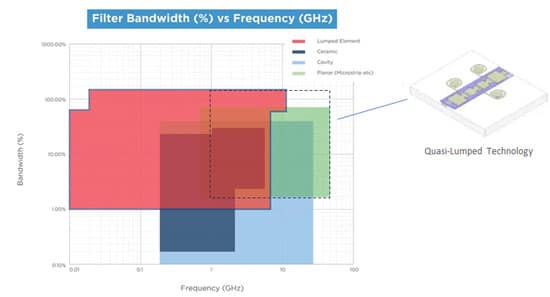
In the Webinar, Jared covers a few examples of quasi-lumped filters, like the one below in which the planar inductor is spiraled. The spiral helps make it smaller, and its thin line helps with inductance. This is a Quasi-MIM cap because the insulator is thicker and it produces less capacitance than you would see for a traditional capacitor.
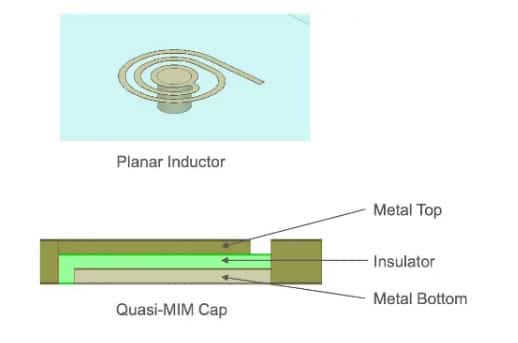
A quasi-lumped approach requires integrating lumped element components, individual inductors and capacitors, into a distributed technology. Planar inductors and MIM capacitors are well suited to integration with a planar filter technology such as microstrip.

For more examples and information on quasi-lumped filters as well as other creative options for developing compact filters for devices with wide operating frequency ranges, watch the on-demand Webinar. 

Read the original post at Quasi-Lumped Filters: Combining Filter Technologies to Create Higher-Value Compact Filters

Previous Post

TDK Unveils EMC Noise Suppression Filters for Audio Lines

Next Post

Samtec Released its Line of Spring-loaded SMPM Adaptors

Related Posts

Littelfuse Announced TVS Diodes for 48 V Automotive Systems
news collection

Littelfuse Announced TVS Diodes for 48 V Automotive Systems

Spectrum Controls Joins Modelithics Program to Offer High‑Fidelity RF Models for Resistors, Attenuators and Terminations
news collection

Spectrum Controls Joins Modelithics Program to Offer High‑Fidelity RF Models for Resistors, Attenuators and Terminations

RF Filters and Passive Components Enabling the 7 Missile RF Subsystems
news collection

RF Filters and Passive Components Enabling the 7 Missile RF Subsystems

Categories

  • ABC of CLR
    • ABC of Capacitors
    • ABC of Inductors
    • ABC of Resistors
    • Mounting Guidelines
  • e-Symposium
    • ESA SPCD
    • PCNS
  • EPCI news
  • Market Insights
  • news collection
  • Transformer: Parasitic parameters and equivalent circuit

    Transformer: Parasitic parameters and equivalent circuit

    0 shares
    Share 0 Tweet 0
  • Transformer Calculation and Applications

    0 shares
    Share 0 Tweet 0
  • Introduction to Ceramic Capacitors

    0 shares
    Share 0 Tweet 0
  • Simulation with LTspice

    0 shares
    Share 0 Tweet 0
  • Dielectric Insulation Resistance, Capacitor DCL Leakage Current and Voltage Breakdown

    0 shares
    Share 0 Tweet 0

© 2024 European Passive Components Institute

No Result
View All Result
  • Home
  • ABC of CLR
    • ABC of Capacitors
    • ABC of Inductors
    • ABC of Resistors
    • Mounting Guidelines
  • e-Symposium
  • EPCI Membership
  • About
This website uses cookies. By continuing to use this website you are giving consent to cookies being used. Visit our Privacy and Cookie Policy.
Go to mobile version