









Wirewound Resistors – Construction, Pulse Load and Types

Wirewound Resistors – Construction, Pulse Load and Types

R 2 WIREWOUND RESISTORS R 2.1     GENERAL COMMENTS As the name indicates wirewound resistors consist of a resistive wire wound on a bobbin and supplied with a protective coating. Since the resistance wire never can serve as a termination wire because of solderability requirements, it has to be connected to the terminal leads or the like, usually by welding or brazing. The higher the...

Noise and Corrosion

Noise and Corrosion

R 1.9 NOISE R 1.9.1 Definition Noise manifests itself as a spontaneously fluctuating voltage whose instantaneous amplitude is randomly distributed. The instantaneous value is both unpredictable and of minor interest except in certain critical applications. Instead, one measures a time-averaged value. It consists of the root of the mean-square value of voltage transmitted in a particular frequency pass band. The noise consists of two...

Resistor Voltage and Frequency Dependence

Resistor Voltage and Frequency Dependence

R 1.11    VOLTAGE DEPENDENCE If we apply a voltage on a resistor, it’s resistance will drop slightly in certain types. Therefore, the resistance change is negative. The change per volt of applied voltage is called voltage coefficient, VC, and is expressed in %/V or better, μV/V. The coefficient is determined not only by the resistive material but also by the dimensions, i.e., the electrical...

Inductance, Impedance and Losses

Inductance, Impedance and Losses

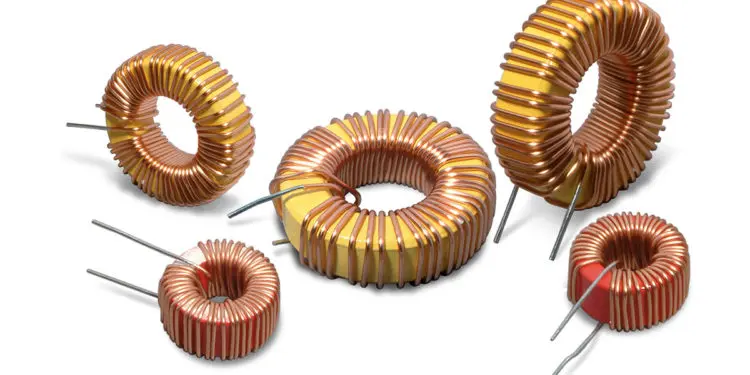
L.1.7 Inductance L Not only magnetic materials possess a magnetic field, every current carrying conductor creates a magnetic field itself. Fig. 1.23: Magnetic fields of current carrying conductors Energy can be temporarily stored in the magnetic field. This effect is technically exploited in coils, consisting of one or more wire windings. The synonymous term “inductor” has become established. There are various types of inductors...

Permeability

Permeability

L.1.6 Permeability μ Permeability describes an important effect in ferromagnetic materials. If a ferromagnetic material is placed in a magnetic field, it is observed that the magnetic flux becomes concentrated in this material. Analogous to electric resistance, the ferromagnetic material presents a good conductor for the field lines. Permeability may therefore be described as a magnetic conducting or penetrating property. Featured Image Fig. 1.16:...

Page 427 of 436 1 426 427 428 436