


• Latest
  • Trending
MLCC Capacitors Benefits in GaN Defense Power Supplies

MLCC Capacitors Benefits in GaN Defense Power Supplies

Skeleton Supercapacitor Achieves UL‑certified 3,500 A Peak Current for AI Data Centers

Skeleton Supercapacitor Achieves UL‑certified 3,500 A Peak Current for AI Data Centers

Bourns Planar Transformers for SiC and GaN Gate Driver Isolation

Bourns Planar Transformers for SiC and GaN Gate Driver Isolation

100 V Hybrid Polymer Capacitor from VINA Enesol Targets 48–72 V Power Platforms

100 V Hybrid Polymer Capacitor from VINA Enesol Targets 48–72 V Power Platforms

Panasonic Releases Relays for IEC 62955 Compliant Single‑Phase EV Wallboxes

Panasonic Releases Relays for IEC 62955 Compliant Single‑Phase EV Wallboxes

KYOCERA AVX Releases NTN Antenna Selection Guide Brochure

KYOCERA AVX Releases NTN Antenna Selection Guide Brochure

Coilcraft Releases 0402 Ferrite-Core Wirewound Chip Inductors for RF and EMI Control

Coilcraft Releases 0402 Ferrite-Core Wirewound Chip Inductors for RF and EMI Control

DigiKey Releases Season Two of Sustainable Futures Series

DigiKey Releases Season Two of Sustainable Futures Series

Using a Virtual Anode Thermal Model to Evaluate Miniaturization Risk in Tantalum Capacitors

Using a Virtual Anode Thermal Model to Evaluate Miniaturization Risk in Tantalum Capacitors

Bourns Introduced High-Current Coupled Inductor for 48 V Hybrid and IBC Converters

Bourns Introduced High-Current Coupled Inductor for 48 V Hybrid and IBC Converters

Würth Elektronik Expands Nanocrystalline Cable Cores for Broadband EMI Suppression

Würth Elektronik Expands Nanocrystalline Cable Cores for Broadband EMI Suppression

  • Home
  • ABC of CLR
    • All
    • ABC of Capacitors
    • ABC of Inductors
    • ABC of Resistors
    • Mounting Guidelines
    RF Inductors and Filters

    RF Inductors and Filters

    Power transformers

    Power transformers

    Telecom transformers

    Telecom transformers

    LAN transformers

    LAN transformers

    Transformer Calculation and Applications

    Transformer Calculation and Applications

    Power Inductors 2 (cont.)

    Power Inductors 2 (cont.)

    Power inductors

    Power inductors

    Current compensated chokes

    Current compensated chokes

    Coil with ferrite

    Coil with ferrite

    • ABC of Capacitors
    • ABC of Inductors
    • ABC of Resistors
    • Mounting Guidelines
  • e-Symposium
  • EPCI Membership
  • About
No Result
View All Result
European Passive Components Institute
  • Home
  • ABC of CLR
    • All
    • ABC of Capacitors
    • ABC of Inductors
    • ABC of Resistors
    • Mounting Guidelines
    RF Inductors and Filters

    RF Inductors and Filters

    Power transformers

    Power transformers

    Telecom transformers

    Telecom transformers

    LAN transformers

    LAN transformers

    Transformer Calculation and Applications

    Transformer Calculation and Applications

    Power Inductors 2 (cont.)

    Power Inductors 2 (cont.)

    Power inductors

    Power inductors

    Current compensated chokes

    Current compensated chokes

    Coil with ferrite

    Coil with ferrite

    • ABC of Capacitors
    • ABC of Inductors
    • ABC of Resistors
    • Mounting Guidelines
  • e-Symposium
  • EPCI Membership
  • About
No Result
View All Result
EPCI
No Result
View All Result
Home news collection

MLCC Capacitors Benefits in GaN Defense Power Supplies

October 23, 2023
Reading Time: 3 mins read
A A
MLCC Capacitors Benefits in GaN Defense Power Supplies

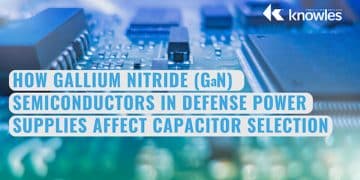
This post by Knowles Precision Devices blog describes how ceramic capacitors have inherent properties that align well with the requirements of GaN-based power electronic designs.

Defense applications tend to operate at high voltages and wide temperature ranges. They require components with increased efficiency, reduced size, and high-power density. Because a wideband gap (WBG) semiconductor embodies these characteristics, defense and aerospace systems are increasingly using Gallium Nitride (GaN) for power conversion. 

Advancements in manufacturing and increasing demand in defense and the consumer market for more efficient power in a compact size have driven down the price of GaN devices. As a result, they are slowly replacing silicon-based Field-Effect Transistor (FET) power supplies.  

Of course, when you change one component as important as a semiconductor in a power supply, you have to change other components, like capacitors, to match new design specifications.  

Benefits of Gallium Nitride Semiconductors 

The benefits GaN semiconductors for defense power supplies over silicon semiconductors include:

  • Lower ON-state resistance: With less ON resistance, the power consumed is typically lower and less heat is generated.
  • Reduced operational heat: GaN devices generate less heat primarily due to their lower conduction and switching losses, extending the lifetime and reliability of the components.
  • Smaller physical footprint: Because of their high-power density of the entire power supply system, devices can be more compact. 

Switching from Silicon to GaN Semiconductors

If you switch to GaN, you must consider how system changes affect system specifications. These changes include:

  • Higher switching frequencies: GaN devices can switch at much higher frequencies than silicon-insulated-gate bipolar transistors. Thus, the power supply can operate at a higher frequency, allowing for smaller capacitors while maintaining the same energy storage capability.
  • Lower voltages: Less power is needed with GaN to drive the circuit. For reference, silicon devices operate at over 3 kV, SiC at 1.7 kV, and GaN at 650 V.
  • Lower inductance: GaN devices can operate with lower inductance, leading to faster switching and reduced switching losses.
  • Easy to parallel: GaN allows for increased power handling capability of high-efficiency and high-power density converters. The characteristic of a temperature-independent threshold voltage makes GaN semiconductors excellent candidates for paralleling in converters. 

With these changes, ceramic capacitors are well-suited to GaN semiconductors in defense power supplies and other industries. 

Why Ceramic Capacitors Are the Best Choice

  • Less chance of overheating: With higher switching frequencies, capacitors will experience higher ripple currents. Ceramic capacitors can best handle ripple currents without overheating or degrading prematurely.
  • Lower equivalent series resistance (ESR): At higher frequencies, the ESR of the capacitor becomes more critical. A lower ESR is desirable to minimize losses and voltage drops across the capacitor. Ceramic capacitors have lower ESR values compared to other capacitors.
  • Lower equivalent series inductance (ESL): The parasitic inductance (ESL) of the capacitor can become a limiting factor at high frequencies. Ceramic capacitors with their lower ESL are preferred in high-frequency applications to minimize voltage spikes and potential ringing.  

Other benefits of ceramic capacitors include voltage ratings, temperature stability, longevity, and reliability.

With GaN semiconductors we are entering a new era of greater efficiency, more compact design, and heightened power density. Specialty ceramic capacitors become even more important as designs of GaN power supplies grow in other industries like automotive, medical systems and advanced scientific applications where compact size and high efficiency are crucial.  

Read the original post at MLCC Capacitors Benefits in GaN Defense Power Supplies
Previous Post

TAIYO YUDEN Completes MLCC Factory at Sarawak, Malaysia

Next Post

NICHICON Launches Miniature Aluminum Electrolytic Capacitors with Long Life

Related Posts

Skeleton Supercapacitor Achieves UL‑certified 3,500 A Peak Current for AI Data Centers
news collection

Skeleton Supercapacitor Achieves UL‑certified 3,500 A Peak Current for AI Data Centers

Bourns Planar Transformers for SiC and GaN Gate Driver Isolation
news collection

Bourns Planar Transformers for SiC and GaN Gate Driver Isolation

100 V Hybrid Polymer Capacitor from VINA Enesol Targets 48–72 V Power Platforms
news collection

100 V Hybrid Polymer Capacitor from VINA Enesol Targets 48–72 V Power Platforms

Categories

  • ABC of CLR
    • ABC of Capacitors
    • ABC of Inductors
    • ABC of Resistors
    • Mounting Guidelines
  • e-Symposium
    • ESA SPCD
    • PCNS
  • EPCI news
  • Market Insights
  • news collection
  • Transformer: Parasitic parameters and equivalent circuit

    Transformer: Parasitic parameters and equivalent circuit

    0 shares
    Share 0 Tweet 0
  • Transformer Calculation and Applications

    0 shares
    Share 0 Tweet 0
  • Introduction to Ceramic Capacitors

    0 shares
    Share 0 Tweet 0
  • Simulation with LTspice

    0 shares
    Share 0 Tweet 0
  • Dielectric Insulation Resistance, Capacitor DCL Leakage Current and Voltage Breakdown

    0 shares
    Share 0 Tweet 0

© 2024 European Passive Components Institute

No Result
View All Result
  • Home
  • ABC of CLR
    • ABC of Capacitors
    • ABC of Inductors
    • ABC of Resistors
    • Mounting Guidelines
  • e-Symposium
  • EPCI Membership
  • About
This website uses cookies. By continuing to use this website you are giving consent to cookies being used. Visit our Privacy and Cookie Policy.
Go to mobile version