




• Latest
  • Trending
Acoustic Effect of Harmonic Distortions Caused by Aluminum Electrolytic Capacitors: Myth Denial

Acoustic Effect of Harmonic Distortions Caused by Aluminum Electrolytic Capacitors: Myth Denial

Vishay Releases High‑Current Radial Inductors up to 209 A

Vishay Releases High‑Current Radial Inductors up to 209 A

May 2026 Interconnect, Passives and Electromechanical Components Market Insights

May 2026 Interconnect, Passives and Electromechanical Components Market Insights

Passive Components Enable Safe and Reliable ADAS Architectures

Passive Components Enable Safe and Reliable ADAS Architectures

Current Sense Transformer Datasheet and Design‑in Guide

Current Sense Transformer Datasheet and Design‑in Guide

Designing a USB Type‑C Flyback Planar Transformer with Frenetic’s Planar Tool

Designing a USB Type‑C Flyback Planar Transformer with Frenetic’s Planar Tool

YMIN Releases Square Supercapacitors for AI Server Power System

YMIN Releases Square Supercapacitors for AI Server Power System

Exxelia Extends Temperature Range of its PP Film Capacitors to 140C

Exxelia Extends Temperature Range of its PP Film Capacitors to 140C

How Long-Term Storage Causes Aging in Electronic Components

How Long-Term Storage Causes Aging in Electronic Components

Nichicon Presents Self-Charging LTO Board for Maintenance-Free IoT Nodes

Nichicon Presents Self-Charging LTO Board for Maintenance-Free IoT Nodes

Mechanical SSC Testing as a Structural Diagnostic Tool for Tantalum Capacitor Anodes

Mechanical SSC Testing as a Structural Diagnostic Tool for Tantalum Capacitor Anodes

  • Home
  • ABC of CLR
    • All
    • ABC of Capacitors
    • ABC of Inductors
    • ABC of Resistors
    • Mounting Guidelines
    RF Inductors and Filters

    RF Inductors and Filters

    Power transformers

    Power transformers

    Telecom transformers

    Telecom transformers

    LAN transformers

    LAN transformers

    Transformer Calculation and Applications

    Transformer Calculation and Applications

    Power Inductors 2 (cont.)

    Power Inductors 2 (cont.)

    Power inductors

    Power inductors

    Current compensated chokes

    Current compensated chokes

    Coil with ferrite

    Coil with ferrite

    • ABC of Capacitors
    • ABC of Inductors
    • ABC of Resistors
    • Mounting Guidelines
  • e-Symposium
  • EPCI Membership
  • About
No Result
View All Result
European Passive Components Institute
  • Home
  • ABC of CLR
    • All
    • ABC of Capacitors
    • ABC of Inductors
    • ABC of Resistors
    • Mounting Guidelines
    RF Inductors and Filters

    RF Inductors and Filters

    Power transformers

    Power transformers

    Telecom transformers

    Telecom transformers

    LAN transformers

    LAN transformers

    Transformer Calculation and Applications

    Transformer Calculation and Applications

    Power Inductors 2 (cont.)

    Power Inductors 2 (cont.)

    Power inductors

    Power inductors

    Current compensated chokes

    Current compensated chokes

    Coil with ferrite

    Coil with ferrite

    • ABC of Capacitors
    • ABC of Inductors
    • ABC of Resistors
    • Mounting Guidelines
  • e-Symposium
  • EPCI Membership
  • About
No Result
View All Result
EPCI
No Result
View All Result
Home news collection

Acoustic Effect of Harmonic Distortions Caused by Aluminum Electrolytic Capacitors: Myth Denial

February 16, 2024
Reading Time: 2 mins read
A A
Acoustic Effect of Harmonic Distortions Caused by Aluminum Electrolytic Capacitors: Myth Denial

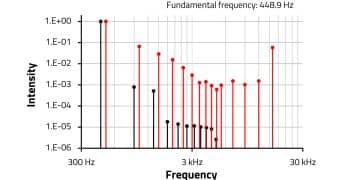
Würth Elektronik’s Application Note ANP125 publishes the results of a study “The acoustic effects of harmonic distortion of aluminum electrolytic capacitors” on harmonic distortion of electrolytic capacitors. The result: Capacitors don’t cause any appreciable signal distortion.

The discussion is ongoing in the audio technology world about what circuit elements affect the sound quality of amplifiers.

The app note by Würth Elektronik provides empirical evidence to add to this discussion and answers questions that most audio engineers have.

Application Note ANP125 is the result of international research collaboration between R&D teams at production sites in Asia and the Würth Elektronik Competence Center in Berlin. The text begins with an introduction to human hearing and psychoacoustics and goes on to examine harmonic distortions in capacitors. Furthermore, results from model calculations are presented in order to check the plausibility of the measured results. The measurements show no appreciable distortion of signals caused by capacitors.

Material variations also tested

Dr. René Kalbitz, Product Manager in the Capacitors & Resistors Division at Würth Elektronik eiSos and author of the study, explains:

“The investigations indicate that material variations have a negligible influence on distortions, and these are below the hearing threshold. Electrolytic capacitors do not add any appreciable harmonics to the fundamental frequencies in signal transmission, so, to a good approximation, they can be considered as linear components. It is likely that other voltage-independent capacitor types and passive components, as a rule, generate similarly low distortion amplitudes compared to the audibility threshold. Consequently, the choice of non-linear components such as operational amplifiers and diodes has a greater distortion impact on the audio quality of the amplifier, i.e., the overall distortion characteristics, than the choice of electrolytic capacitor.”

Abstract

This application reports a study of total harmonic distortions (THD) caused by commercial electrolytic capacitors, as produced by Würth Elektronik eiSos, as well as purpose-built items.

In order to find parameters that influence the THD, capacitors with different separation paper and electrolyte compositions have been investigated. Those sample capacitors were assembled at near mass production conditions at a production site and analyzed at the electrical laboratory of Würth Elektronik in Berlin.

At first, the appnote provides an introduction into the field of human hearing and psychoacoustics before approaching the study of harmonic distortions in capacitors. It furthermore introduces results from model calculations to check the plausibility of the measured results.

The results suggest that the harmonic distortions are well below the threshold of audibility. It can be concluded that the capacitors do not add significant distortions to fundamental frequencies as they transfer signals. Modifications of the electrolyte or separation paper have a negligible effect on the THD.

Content:

  • Introduction to human hearing
  • THD of a Capacitor Model
  • Experiment Details
  • Measured THD of 470 µF Electrolytic Capacitor
  • Comparative Analysis of Capacitors

See the detailed application report at the link here:

Read the original post at Acoustic Effect of Harmonic Distortions Caused by Aluminum Electrolytic Capacitors: Myth Denial

Previous Post

Power Supply Efficiency Improvements at Low Load Conditions; WE Webinar

Next Post

Bel Fuse Releases Industry’s First 240VAC SMD Resettable Fuse

Related Posts

Vishay Releases High‑Current Radial Inductors up to 209 A
news collection

Vishay Releases High‑Current Radial Inductors up to 209 A

May 2026 Interconnect, Passives and Electromechanical Components Market Insights
news collection

May 2026 Interconnect, Passives and Electromechanical Components Market Insights

Passive Components Enable Safe and Reliable ADAS Architectures
news collection

Passive Components Enable Safe and Reliable ADAS Architectures

Categories

  • ABC of CLR
    • ABC of Capacitors
    • ABC of Inductors
    • ABC of Resistors
    • Mounting Guidelines
  • e-Symposium
    • ESA SPCD
    • PCNS
  • EPCI news
  • Market Insights
  • news collection
  • Transformer: Parasitic parameters and equivalent circuit

    Transformer: Parasitic parameters and equivalent circuit

    0 shares
    Share 0 Tweet 0
  • Transformer Calculation and Applications

    0 shares
    Share 0 Tweet 0
  • Introduction to Ceramic Capacitors

    0 shares
    Share 0 Tweet 0
  • Simulation with LTspice

    0 shares
    Share 0 Tweet 0
  • Dielectric Insulation Resistance, Capacitor DCL Leakage Current and Voltage Breakdown

    0 shares
    Share 0 Tweet 0

© 2024 European Passive Components Institute

No Result
View All Result
  • Home
  • ABC of CLR
    • ABC of Capacitors
    • ABC of Inductors
    • ABC of Resistors
    • Mounting Guidelines
  • e-Symposium
  • EPCI Membership
  • About
This website uses cookies. By continuing to use this website you are giving consent to cookies being used. Visit our Privacy and Cookie Policy.
Go to mobile version